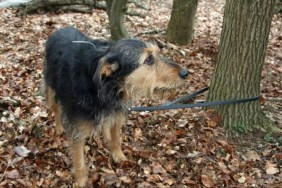

There are several LEASH TRICKS that I teach all dogs. Mostly this is to ease my own frustration; I am lazy about leashes. I want the dog to think about and work at keeping the leash out of trouble.
These are my TOP LEASH-SKILL ANNOYANCES.
- Stepping over the leash...
- Winding around the wrong side of a pole...
- Cutting from side to side & stalling to sniff...
I'm not unreasonable, I realize that it is normal dog behavior. In fact, I expected that most green dogs will do these things. This doesn't mean that you can't change their behavior. Before you expect your dog to change their behavior, you must put some time into teaching them new behaviors. These new behaviors will eventually replace the old behaviors.
MY FIRST & FAVORITE Leash Trick, "FIX-IT!"
I use FIX-IT in situations where dogs step over the leash. Puppies do this a lot and get the leash stuck in their paw-pit. Once its stuck under their leg, they tend to either stall or have a temper tantrum and chew at the leash. This is understandable, but it can lead to a chain of attention-seeking behaviors that later become a problem.
I prefer teaching FIX-IT on my terms. By this I mean that a start off each walk deliberately placing the leash under one paw and then practice the FIX-IT with lots of help and rewards. Then if the leash gets stuck on the walk, we practice again.
How To Teach "FIX-IT"
WHAT YOU NEED:
-
A 5-6' leather or nylon leash.
-
15-20 pieces of a yummy treat such as cheese, chicken, or soft dog treats.
-
A flat surface.
-
A clicker (optional)

INSTRUCTIONS:
- Clip a 5-6' leash on your pups FLAT BUCKLE/CLIP COLLAR.
- Allow the leash to drag on the ground so that your pup steps over it (avoid handling your pups paws!)
- Gently lift the leash. Your pups paw should be relaxed and you should be able to raise and lower the paw several times.
- If the leash gets stuck in the armpit, you are using too much tension; give your leash more slack.
- If your puppy chews the leash, you are using too much tension; give your leash more slack.
- If your pup does any lifting of the paw on her own, Praise (or, click) & Feed (regardless of where the leash is).
- Continue to gentle lift and lower the leash which will raise your dogs paw. Do this slowly.
- Praise (click) & Feed all attempts by the pup to lift their own leg.
- As soon as the leash is unstuck, JACKPOT* (toss 5-10 treats) to your dog.
- Continue this for 5-10 minutes at the beginning of all walks for about 1-week.
- You will soon notice that your pup quickly and easily raises her paw when the leash gets stuck.
- When you are certain that your pup "knows" what he is doing, then you can say, "FIX-IT"
- When you add the command, only Praise & Treat the dog if you use the command. Occasionally omit the command, wait for your dog to fix the leash and then move on without Praising & Treating --this will motivate your dog to do it faster when you say "FIX-IT."
*Jackpot your dog, even if you think it was an accident that the leash become untuck. In the beginning your dog does not need to have intentionally done the job.
A normal, healthy pup will want to bite and chew--on EVERYTHING!
This means your pup will try biting you!
RELAX! Your puppy is NOT aggressive.
Your puppy is not trying to dominate you.
Your puppy is not being naughty.
Your puppy is just being a puppy!
This does not mean that you should encourage biting. Furthermore, this does not mean you should ignore your puppy's inappropriate biting. It is important to address biting BEFORE it becomes a problem!
Some Background...
Puppies have very sharp, needle-shaped teeth. When a puppy bites, these teeth hurt, a lot! This is good. Puppies lack adult-dog, jaw strength. If they didn't have such sharp teeth, it would be hard for them to realize that they are capable of hurting others with their teeth.
Puppies need to learn BITE INHIBITION. This is a term that is used by veterinarians, trainers, and behaviorists to describe how hard a dog bites down when they place their mouth and jaws on a person or dog. Think of your dog's teeth like the brakes in your car. You can press the brakes gently or slam on them. At some point when you are driving you will need to brake, but how you brake depends on lots of factors... Is there a threat, are you going slow or fast, have you been paying attention, etc...
At some point in your dog's life they are likely to use their teeth in a fight, or to protect themselves or their stuff. When this happens you want them to inhibit themselves and use the minimal tooth & jaw pressure needed to make their point.
When Your Puppy Puts Their Teeth on Your Skin...
I allow gentle mouthing until pups are about 3-4 months old (they start getting adult teeth).
This is because I want my puppy to practice using their jaws gently. When a pup bites too hard, I say "OUCH!" in a calm, but clear voice. Then I walk away from my pup. I do not shove, grab, hit, or otherwise try to give the puppy a punishment. Don't hold their mouth shut or yell at them. The punishment is that you ignore them.
All puppies need SOME rough-play time. If my pup is too worked-up to use their jaws calmly, I bring a toy into the situation. They are allowed to be rough, bite, shake and growl at the toy. BUT... If they miss the toy and bite me by mistake, I say, "OUCH!" and walk away for 10-15 seconds. They get three attempts. On the third mistake, I stop playing with them for at least 20 minutes.
Once a pup is 3-4 months, I no longer allow teeth on skin. Should a pup make a mistake, I do the following:
1) On the first mistake, I re-direct them to a toy.
2) On the second mistake, they get an "OUCH!" and ignored.
3) On the third mistake, they get put in a confinement area until they calm down.
FINAL NOTE!
Give your puppy LOTS of toys, bones, and chews!!!
Teach your dog TUG!
>>>READ MORE ON TUG, CLICK HERE.
Teaching Dogs to "Swim"
Not All Dogs Like Water...
And, not all dogs CAN swim!
But, waders can have fun too!
Tips for Hydrophobic (behaviorally, not clinically) Dogs
If you want your dog to like or love something, you must find a way for them to associate that thing with good things. If they are too nervous, scared or shy to try the thing you want them to like then you have to start really slow.
Starting slow means:
REWARD (toys & treats work the fastest) any and all interest in the activity or item. This can mean praising and treating the dog for looking at the pool of water, moving towards it or sniffing the edge.
REPEAT the same exercise over and over again in SHORT intervals. Try starting with 5-minutes at a time, then leave and go do something else for 10-15 minutes. Try 3 or 4 short sessions once or twice a day.
JACKPOT your dog with a huge surprise of yummy treats of an extra special version of a toy (squeaky tennis ball vs. regular ball) for any extra brave attempts or sudden bursts of enthusiasm.
OBSERVE & IMPROVE on the required level of interest only when your dog is clearly ready to move onto the next level. If they aren't consistently sniff putting one paw on the edge they are NOT ready for putting one paw IN the water. Wait and keep rewarding just one paw on the edge.
***Fatal Errors***
Forcing a dog to do something and hoping they will figure out it isn't so bad.
Forcing a dog to do something and then letting them ESCAPE and giving them semi-interesting rewards/good stuff.
Trying to sooth a dog with words and kind petting while they are freaking out.
Forcing a dog to stay in water once they decide to go it = punishment for trying (let them escape so they can do it again).
Filling the pool with a big scary hose while the dog is learning.
Doing swim/play in the bath area.
DO...
Let your dog escape once they go in.
Let your dog decide they are done for the day.
Try using toys/food as a bribe to get in, BUT be sure to REWARD (more treats/play) AFTER the dog gets in even if they pop out.
Use really, really tasty treats or your dog favorite toy.
Start with a shallow pool and clear water with no waves or spray.
Teach your dog to TAKE-A-BOW!

Many of my clients dogs have a hard time playing with and interacting with other dogs. These dogs often play well with well-known, "buddy-dogs" and demonstrates good play-skills in comfortable situations, but do poorly with new dogs or in new places.
With work the dog can learn to meet and greet the novel dogs without being inappropriate, but there is often no play. In these cases the dog-in-training often starts getting jumped by the other dogs (in a not so friendly way). This happens after the Meet-&-Greet, because the dog-in-training sniffs a hello and then just stands there stiffly. This is awkward and invites aggressiion -a sort of preemptive strike against the dog who is standing stiffly and giving everyone the willies.
In these cases teaching a PLAY-BOW can bridge the gap between meeting and becoming friends. It gives the dog-in-training something to do (besides standing awkwardly). Furthermore, despite its trained-awkwardness it gives the other dogs something to do too -they can respond with more playfulness.
How To Teach A Play-Bow
Dog is standing...
1. Take a small treat and place it on your dogs nose.
2. Let your dog smell and lick at the treat, but don't let them eat it.
3. Slowly, very SLOWLY move the treat from your dog's nose in a straight-line down to the floor (right between your dogs front paws).
4. If your dog bends her elbows (even a little) while her tail-end is still in the air (not a down), praise and treat your dog.
If your dog's bottom flops to the ground, pull the treat away, stand-up and move away form your dog. Wait until your dog is standing to begin again.
5. Keep doing this for 5 or 10 minutes everyday until your dog easily goes into the position shown above.
NOW ADD THE COMMAND
a. Call it something cute! I like: "Go play" or "New Friend"
b. Say this new phrase or the word, BOW
c. Then pause.... wait 10-15 seconds.
d. Now give your dog a HINT: lure the trick.
If your dog does it, praise and treat your dog.
e. Repeat. Repeat. Repeat.
f. When your dog finally does this after the command and BEFORE the hint, JACKPOT your dog with 7 or 8 treats all at once!
g. Repeat some more.
h. Take it on the road; try it outside with no dogs around.
Don't be surprised if your dog needs a review in new places or once dogs are around.
Include a picture of YOUR DOG'S PLAY-BOW.
Comment below & send the pic to: kelley@dogEvolve.com
Nicole's dog CLOVER

READER QUESTION
My granddog is a boxer female 26 months old. In the mornings when I try to get her to go outside she snaps and growls at me. Can a dog sleep with a muzzle on? If they can is the my best plan of attack or put her back in her cage. Sincerely KB Houston TX
Dear KB,
Of course your dog could sleep with a muzzle on, but I wouldn't recommend it. I almost always reserve muzzles for dogs that BITE. Snapping & growling are warning behaviors -it is not to late to fix this problem. Both you and your dog deserve to sleep and wake-up in harmony.
It sounds as if your Boxer is a Bed Guarder. On the Guarding Scale (1-10) your dog is a light-weight. She only guards the bed, after having been there all night. Heavy-Duty Guarders will claim it as theirs (growl/snap/snarl) as soon as they lay down.
I'm not excusing the behavior, but I do understand it. I am a deep sleeper and DO NOT like waking up. I hate waking; I routinely abuse my alarm clock in the morning. The best days start with someone brining me coffee in bed!
Coffee MAKES me happy; coffee is NOT contingent upon my BEING happy :) As you read the following keep this in mind --The coffee I get in the morning is NOT a reward for waking up in a good mood. The coffee is a nice way to prevent me from being cranky.
By contrast, punishments for 'grumpy morning behavior' will not work. Think about it. If you already hate waking up to leave your warm, cozy bed your attitude will not likely improve if you get in trouble for not being a morning person.
WARNING:
Punishments: yelling, hitting, squirting, dragging, pinning, rolling, etc WILL MAKE CERTAIN BEHAVIOR PROBLEMS WORSE. In this case, the dog already hates leaving the bed in the morning. She is NOT is her right mind --me before coffee (cranky!) Punishments for cranky morning behavior will make your dog have an even bigger negative (yucky) association with waking up.
Try this instead...
1. Before you wake your dog, go to the fridge.
2. Get something tasty (some cheese or a hotdog).
3. Approach your dog, but stop before you are so close that she will yell at you.
4. Then, say something in a sweat voice: "Morning Girl -Rise & Shine." The phrase can be whatever you like saying and can say nicely.
5. Then toss a treat, right to her. Toss it on the bed, or even bounce it off her head.
DO NOT WORRY IF SHE BARKS OR GROWLS -Remember she is NOT a morning dog. She doesn't mean anything by it, she's just grumpy.
6. If she eats the treat, toss another and then toss the rest on the ground.
7. As soon as she is on the floor call her to the door and give her once last treat.
Please see the following ARTICLES for more information.
Dog Faces: Reading Body Language
Muzzles -When & How Should They Be Used?
Muzzles --Is Aggression The Only Use?