






Did you know that you have more bacteria living in your intestines than you have cells in your body?
Did you know that most of the different species of bacteria living in your intestines are there to keep you healthy? Did you know that some researchers now consider these bugs, or your "microbiota", as a distinct organ, much the same way they view an organ system like the liver or the heart and lungs?
You've probably seen the advertisements on TV for different yogurt or liquid probiotic supplements, many available in the grocery store, that make vague claims about "regularity" or feeling "balanced," whatever that means.
So ,just what are probiotics and what do they do to help keep us healthy?
First, lets get a few basics down. The gastrointestinal tract is the organ that most of us associate simply with processing and digesting food and disposing of waste products in the process. That's all true, but in addition, the GI tract is the largest immune organ in the body. In fact 25% of the gut is composed of immune system tissue and the gut represents fully 70% of the entire body's immune capacity.
When you think about that it really makes sense. Much of the foreign stuff that enters our bodies comes via the gut and if you need a first line of defense that's a good place to start. Many of the cells and antibodies we produce to fight off disease-causing-organisms are made in the gut and the resident bacteria play an important role in this process.
In addition to the good bacteria, the intestine plays host to many so called bad bacteria. These good and bad bacteria live in a balance and the good bacteria play an important role in keeping the bad bacteria in check. Intestinal problems like diarrhea can get started when things are out of  whack and the balance tips over to the e. coli or salmonella sp.
Probiotics are simply a heaping dose of good bacteria. You can take them regularly to help stimulate your immune system and maintain balance and we can use them to re-establish a healthy gut where the balance has shifted to the bad. In veterinary medicine, we use them most often in cases of digestive upset or where the gut immune system is out of whack.
To better understand how that works you have to know something about what these bugs actually do in the gut. Since I don't want this post to read like the dead sea scrolls I'll save that for later this week.
Yesterday, Tom and I met with Jason Merrihew from the AAHA. How many of you know what the AAHA is? Not many, I think. I didn't really know what they were, or who they were, until our visit to the NAVC, last month. We stopped by their booth and learned that they're the American Animal Hospital Association. They exist to accredit animal hospitals for veterinary excellence. Jason told us that there are 900 standards each accredited hospital has to pass to earn AAHA accreditation.
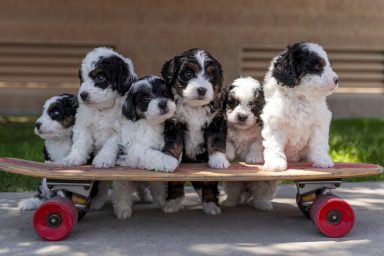
This year, interestingly, AAHA has partnered with Animal Planet on sponsoring the Puppy Bowl. How kewl is that? Really now...when it comes to "bowls" on TV, this one has to take the highest marks. Puppies in a contest...running around chasing each other...just being...puppies!
I know where my TV is going to be turned, tomorrow: to Animal Planet at 3pm e/p. (there's a Game Day Pet Photo Contest, too! W00t!)
If you don't know what the Puppy Bowl is, and if you haven't already seen my post on this over at S&S, here's the scoop: The Puppy Bowl is a fun event for those of us who need a little entertainment on Sunday, and who aren't necessarily into that 'other' bowl. As part of the sponsorship of the Puppy Bowl, the AAHA is featuring 15-second ads and 30-second commercials on Animal Planet during the pet and wildlife-related programming. AAHA's message this year is on pet nutrition (we talk about that a lot here), pain management, wellness, and the importance of accreditation.
One goal is to educate consumers (pet folks) on what the AAHA does - and maybe give folks some insight into what it means to be accredited. Not to mention, Dr. Elisa Mazzaferro, from the local Wheat Ridge Animal Hospital (local to me, here in Frederick, CO), has been chosen as the offical AAHA veterinarian and she will be participating LIVE on twitter - to answer your questions. Be sure to follow @healthypet and join the conversation.
Who can resist the Puppy Bowl? Even if you're planning to watch that other bowl show, you'll want to click into the Puppy Bowl now and then to see what's up, or down, or rolling all around! See you there!
Las Vegas is a great example of the consequences of unbridled development. When the economy turns south, years of speculation take a toll and the toll falls on people and their pets. Reports indicate that the number of dogs given up at the main public shelter in Las Vegas is up 10% annually in each of the last three years. The LIED in animal shelter in Las Vegas takes in 50,000 animals a year and 50% end up being euthanized.
The City Council reacted last fall with an ordinance mandating that pet owners spay or neuter their pets by four months of age. There are exceptions for medical reasons and breeders pay a fee to continue their operations. Fine are substantial and the proceeds are supposed to be used to help defray surgical costs for low income pet owners.
On the surface this sounds like a reasonable reaction to a serious problem and you have to credit these officials for trying to do something. On the other hand it's not a perfect solution by any stretch.
If you read this blog you probably already have your dog spayed or neutered. Even if you are not wealthy, you probably weighed the financial responsibility of pet ownership when you got your critter and figured out a way to deal with it. Some folks aren't that lucky. The economic consequences of laws like these fall disproportionately on low income people. They may love their dog or cat but simply not have the resources to pay for a surgery, if they are out of work.
One unintended consequence of a law like this may be even more dogs and cats given up for adoption. Many may simply choose not to license their animals and funds for animal welfare may suffer as a result. Commercial breeders get a pass, too, and when you consider that by some estimates, 25-30% of pets in shelters originate at puppy mills, that does not seem fair.
It would seem that there should be some consideration for subsidizing surgery for some individuals based on need if they are expected to comply with a law like this. Apparently, there are low cost options available in Las Vegas but they may be overwhelmed by something like this.
The law goes into effect on April first. It will be interesting to see what happens. Seems like a roll of the dice to me.
We've taken to calling our Wabby, the 17 year old resident kitty, The Grumpy Old Lady - just look at her picture and tell me she doesn't look like she not only got up on the wrong side of the bed, but that she doesn't even know where the right side of the bed is!
Anyway, she's become extremely vocal, of late. I don't know if it's because of the move, or just that she's a bit senile. In human years we figure she's well into her 90s, and I've heard that dogs and cats have their own form of senility, as they age. So, every morning around 5 a.m. the Wabby drags herself off of the bed (where she positions herself just so - just so Tom and I can't move our feet anywhere without kicking her), and makes her way downstairs.
Once at the landing, she lies down and meows. Ok, she wails. She sounds like she's dying. Sometimes the wailing is a bit faint, so we know she's strolling around the kitchen talking to ... the chairs? The table? The closed pantry door?
I wonder if she's looking for something particular. Maybe we left something (a certain smell or a certain ambience?) behind at the old house, that she can't find here. Maybe...and this is scary...she's looking for Carmie! She never did seem to believe Carmie was gone. When we moved Carmie's bed (after almost a whole year of her having passed over the Rainbow Bridge), the Wabby sat in our room and stared at the space Carmie's bed used to be.
Then, she would slowly turn her head and give us her "evil" stare. It was clear she did not approve. (as if she ever even sat on the bed or anything!)
Anyway, she's speaking out loud and clear in this new home. She's searching for something. Or, she's just being smart - that loud wailing gets us up, eventually. Whereupon it turns to the sweet little meows that melt our hearts.
Hmmm...what is it she really wants? Maybe, like her friend Romeo, she just wants breakfast!
It's that time of year again. Mid winter, terrible weather, cold and flu season and of course; Pet Dental Health Month. Yea February. Seriously, about the only good thing you can say about February, unless you live in the Southern Hemisphere, is that my son Drew was born in February. He'll be thirty this year. Yikes.
On the dental health month front, this is the time of year when many veterinarians get involved in client education efforts on the benefits of routine dental health care for dogs and cats. I think most people understand the logic behind this. Most of us brush our own teeth two times a day and we understand the benefits of flossing and all that.
The problem is that our pets can't brush their own teeth. Imagine what your mouth would be like if you went a year without brushing or flossing? Gross is a word that comes to mind.
There are some precautions we can take however. We can brush our pet's teeth. Are you saying "gross" again? It's really not much more gross than playing fetch with an old tennis ball right? That's actually pretty gross, too, come to think about it.
I think one of the big reasons we don't brush our pet's teeth is that we don't know how to do it properly. We may get too impatient. If you go out and get all the right tools, special doggie or kitty tooth brushes and tooth paste, and start right in you will probably fail. In many cases it devolves into a wrestling match with disappointing results for both parties.
The best way to do it successfully is to be very patient getting started. It may take a couple of weeks of progressive handling of your pet's mouth to get them to stand still for the procedure. If you start with that mindset you just might succeed.
As part of Pet Dental Health Month I came across a pretty good video by Shelly Rubin on how to go about home dental care for your pet. Dr. Rubin covers the whys and the hows pretty well. He shows you how to accustom your pet to you sticking your fingers in their mouth's. He then shows you how to progress to actual brushing.
He also covers a variety of toys and chews for those of you that are on the squeamish side. The results won't be as good as actual brushing, but it's a lot better than no care at all.
One big reason why you should consider home dental care is the cost of doing nothing. If you wait until things have gotten out of hand it's not too hard to run up a bill of $400 to $500 bucks for a thorough dental cleaning by your veterinarian. You may need to do that periodically, anyway, but if you practice good home care you'll have to do it less often and your pet will thank you for that. They like going to the "dentist" about as much as you do.
So take a gander at this video. It just might get you into a program of home dental care.
|
|